





Table of Contents
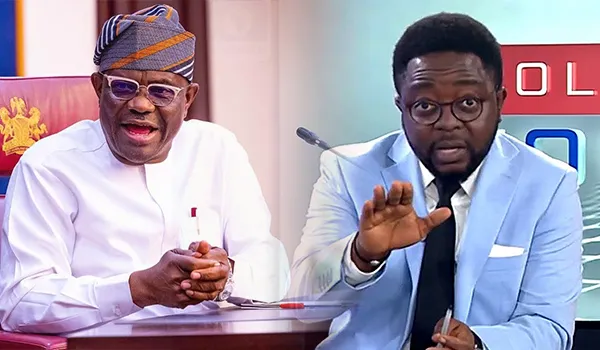
Seun Okinbaloye not afraid of Wike’s threat and he made that crystal clear on national television. The veteran Channels Television anchor broke his silence on Sunday, April 5, 2026, during the evening edition of Politics Today, delivering one of the most defiant and widely watched broadcasts in recent Nigerian media history. His response came after FCT Minister Nyesom Wike made a chilling remark suggesting he would have “shot” the journalist over comments made during a live programme a statement that drew immediate national and international condemnation.
1. What Triggered the Wike vs Okinbaloye Crisis
The controversy began during a Wednesday edition of Politics Today on Channels Television, where Okinbaloye raised concerns about Nigeria’s political landscape ahead of the 2027 general elections.
Specifically, Okinbaloye warned that Nigeria’s democracy was at risk of becoming a one-party state pointing to the leadership crisis within the African Democratic Congress (ADC) and the implications it carries for viable opposition politics ahead of 2027.
FCT Minister Nyesom Wike, attending a separate media parley in Abuja on Friday, reacted angrily to the journalist’s comments. He accused Okinbaloye of abandoning journalistic neutrality and crossing the line into political commentary, a charge Okinbaloye has firmly rejected.
2. Wike’s Shocking “Shoot Him” Comment
What turned a political disagreement into a national crisis were Wike’s own words. Speaking at the media briefing, the minister said:
“When I was watching Politics Today, Seun… If there was any way to break the screen, I would have shot him.”
The remark detonated immediately across Nigerian social media. Critics, journalists, civil society groups, and international organisations condemned the statement as a direct threat against a journalist’s life regardless of context or intent.
Wike’s aide, Lere Olayinka, subsequently issued a damage-control statement claiming the remark was made “in a hyperbolic context… without intent,” and that the minister was simply reacting to what he perceived as Okinbaloye’s bias. But the clarification did little to douse the outrage. As Amnesty International noted, violent language regardless of intent has no place in democratic discourse.
3. Seun Okinbaloye Not Afraid: His 5 Most Powerful Declarations
When Seun Okinbaloye finally spoke on Sunday, he did not hold back. Here are his five most powerful statements that reverberated across Nigeria:
- “I am not afraid and I will never be intimidated.”
Okinbaloye’s clearest and most direct response delivered calmly but firmly on national television, signalling that Seun Okinbaloye not afraid of Wike’s threat and has no intention of backing down. - “Journalism grounded in ethics and global best practices remains a duty to the public, not a concession to power.”
A reminder that a journalist’s responsibility is to citizens not to the comfort of those in authority. - “Our democracy is in danger if we allow one-way traffic in balloting.”
Doubling down on the very comment that triggered Wike’s outburst showing Okinbaloye stands fully by his original position. - “Violent rhetoric or suggesting threats are never appropriate responses in a decent democratic society.”
A pointed rebuke of Wike’s “shoot him” language, even as he acknowledged the minister’s personal call to clarify. - “I will continue to do what I love asking the necessary questions, holding power to account. If that commitment comes at a cost, so be it.”
Perhaps his most defining statement a declaration that Seun Okinbaloye not afraid of Wike’s threat or any consequence that may follow his journalism.
4. Wike Calls Okinbaloye — What Was Said
In a development that surprised many observers, Okinbaloye revealed during his broadcast that Minister Wike personally called him to clarify his remarks.
Okinbaloye stated: “I received a call from the honourable minister, who clarified that the intention was not as conveyed.”
While he acknowledged the call and noted the clarification, Okinbaloye made clear that a private phone call does not resolve the broader issue of violent language by public officials toward journalists. He emphasised that such rhetoric — particularly during an active election season could be exploited by individuals with “harmful intentions” and therefore carries real-world danger regardless of what was privately intended.
The anchor also confirmed that the Department of State Services (DSS) has been providing ongoing security assurances following the incident a fact that underscores how seriously the threat was taken by Nigeria’s own security apparatus.
5. Amnesty International, Civil Society and Public Condemnation
The response to Wike’s “shoot him” remark was swift and widespread, both within Nigeria and internationally.
- Amnesty International Nigeria condemned the statement as “reckless and violent language”, warning it could incite attacks on journalists and undermine press freedom across the country.
- The African Action Congress (AAC), in a statement signed by National Publicity Secretary Rex I. Elanu, described Wike’s outburst as “dangerous and unacceptable”, stressing that Okinbaloye was performing his constitutional duty.
- Civil society organisations from across Nigeria rallied behind the journalist, flooding social media with messages of solidarity.
- International press freedom organisations also weighed in, with several monitoring the situation closely given its implications for media independence in Nigeria.
Okinbaloye acknowledged all of this support during his broadcast, saying their solidarity “reinforces our collective commitment to truth and accountability.”
For more on press freedom standards in Nigeria, see Reporters Without Borders’ Nigeria Press Freedom Index.
6. Why This Matters for Nigeria’s Democracy
The fact that Seun Okinbaloye not afraid of Wike’s threat is personally courageous but the incident itself reveals something far more concerning about the state of Nigerian democracy in 2026.
When a sitting federal minister publicly suggests he would “shoot” a journalist for raising concerns about a one-party state, it sends a chilling message to every reporter, presenter, editor, and citizen journalist in the country: ask uncomfortable questions at your own risk.
Nigeria’s United Nations human rights obligations include the protection of freedom of expression and press independence. Threatening language from powerful government officials even if later described as hyperbolic directly undermines those obligations and creates an environment of fear that self-censorship thrives in.
With 2027 elections approaching and opposition politics already under strain from the ADC leadership crisis, the last thing Nigeria’s democratic space needs is a culture where journalists fear for their lives for doing their jobs. Read our related coverage on the ADC leadership crisis and the forged resignation letter scandal.
7. Conclusion: A Line Has Been Drawn
Seun Okinbaloye not afraid of Wike’s threat and by saying so publicly, on the same platform where the controversy erupted, he has drawn a clear line between power and the press in Nigeria.
His defiance is not just personal bravery. It is a statement on behalf of every journalist in Nigeria who has ever self-censored out of fear, every newsroom that has pulled a story under pressure, and every citizen who depends on a free press to hold their government to account.
Nyesom Wike may have called to clarify. The DSS may be providing security assurances. But the damage of those words and the courage of Okinbaloye’s response will define this moment in Nigerian media history long after the headlines fade.
Follow our News section for more breaking Nigerian stories. Also read: Terrorists Attack Kwara Deputy Governor’s Hometown 2 Killed.