



















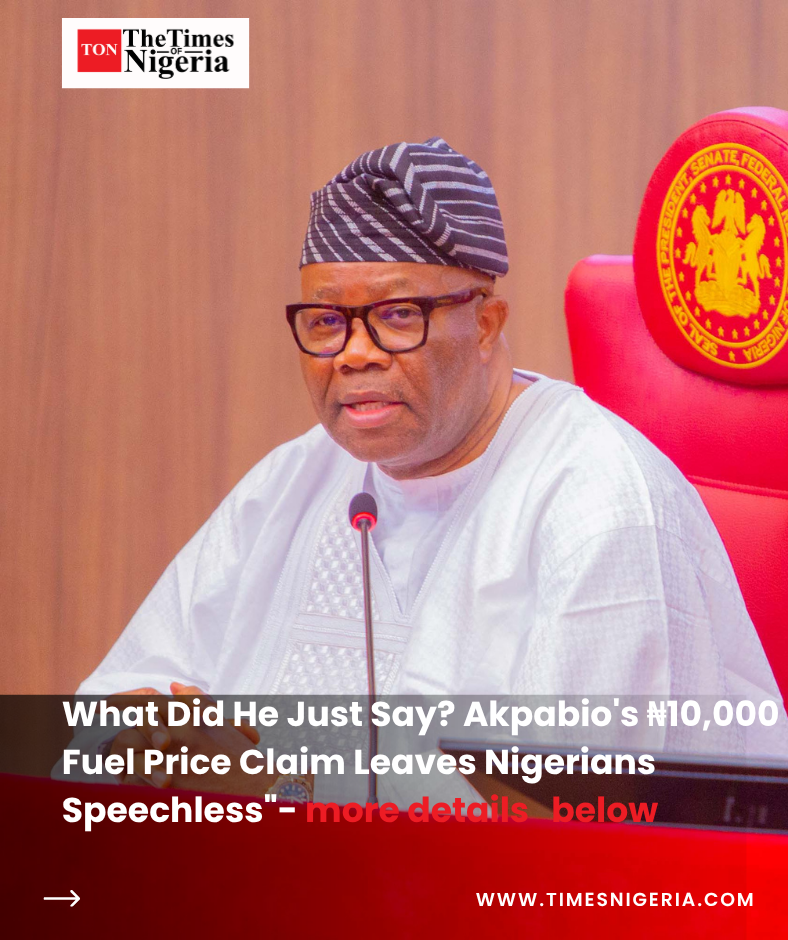
Akpabio fuel price claim
A fresh wave of public outrage has swept across Nigeria following a stunning Akpabio fuel price claim that has left many citizens speechless.
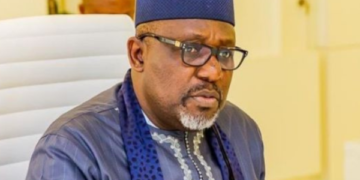
Senate President Godswill Akpabio reportedly made the controversial statement suggesting that Nigerians will someday be ready and willing to pay as much as ₦10,000 per litre of fuel a remark that has since gone viral and ignited fierce debate about the state of Nigeria’s economy, governance, and the growing cost of living crisis facing ordinary citizens.
What Akpabio Said About Fuel Prices in Nigeria
The Akpabio fuel price claim was made during a public engagement where the Senate President appeared to be defending or contextualizing the federal government’s fuel pricing policies following the controversial removal of the fuel subsidy.
According to reports by Legit.ng, Akpabio stated that there will come a time when Nigerians will be prepared to pay as high as ₦10,000 per litre of petrol, seemingly framing current fuel prices already considered unaffordable by millions as relatively manageable in comparison to what lies ahead.
The statement, whether intended as a warning, a projection, or a justification, has been interpreted by many Nigerians as deeply insensitive and disconnected from the daily realities of the average citizen who is already struggling to cope with petrol prices that have skyrocketed since the subsidy removal under
President Bola Tinubu’s administration in May 2023.
Public Reaction to the Akpabio Fuel Price Claim
The backlash to the Akpabio fuel price claim was swift and intense.
Across social media platforms, Nigerians took to X (formerly Twitter), Facebook, and Instagram to express their anger, disbelief, and frustration over the remark.
Many questioned how a sitting Senate President could make such a statement at a time when the majority of Nigerians are battling hunger, unemployment, and a crippling cost of living crisis.
Civil society groups, labour unions, and political commentators have also condemned the statement in strong terms.
Many have called on Akpabio to retract the comment and apologize to Nigerians, arguing that such remarks from top government officials only further erode public trust in the country’s leadership.
The Akpabio fuel price claim has once again brought the issue of elite disconnect to the forefront of Nigeria’s national conversation.
“A time will come when Nigerians will be ready to pay ₦10,000 per litre
of fuel,” Akpabio reportedly said, according to sources cited by
Context: Nigeria’s Fuel Price Crisis
To fully understand why the Akpabio fuel price claim hit such a raw nerve, it is important to understand the economic backdrop against which it was made.
Since the removal of the fuel subsidy in June 2023, the pump price of Premium Motor Spirit (PMS), commonly known as petrol, has risen from around ₦185 per litre to well over ₦1,000 per litre in many parts of Nigeria as of early 2025 a more than 400% increase in under two years.
This dramatic rise in fuel prices has had a catastrophic ripple effect on virtually every sector of the Nigerian economy.
Transportation costs have surged, food prices have skyrocketed, businesses have struggled to survive, and millions of low-income Nigerians have been pushed further into poverty.
Against this backdrop, the suggestion that Nigerians may one day pay ₦10,000 per litre is not just alarming it is, for many, a declaration of economic war on the poor.
Government’s Position on Fuel Subsidy Removal
The Tinubu administration has consistently maintained that the removal of the fuel subsidy was a necessary and bold economic reform aimed at freeing up government resources for more impactful investments in infrastructure, education, and social welfare.
Top government officials, including the President himself, have repeatedly urged Nigerians to endure the short-term pain for long-term gain.
However, critics argue that the so called palliative measures promised to cushion the effect of subsidy removal have been woefully inadequate and poorly implemented.
The Akpabio fuel price claim, therefore, strikes many as a tone deaf response to a genuine humanitarian crisis one that demands empathy, policy solutions, and decisive action, not provocative projections about future pricing.
Broader Implications: What the Akpabio Fuel Price Claim Means for Nigeria
Beyond the immediate outrage, the Akpabio fuel price claim raises deeper questions about the direction of governance in Nigeria.
When top elected officials make statements that appear to normalize economic hardship rather than commit to solutions, it signals a troubling disconnect between the political class and the people they are meant to serve.
Economists and policy analysts have warned that without a deliberate and effective strategy to stabilize fuel prices, revamp public transportation, diversify the energy mix, and grow the domestic refining capacity, Nigeria
risks deepening its economic inequality at an alarming rate.
The country’s four government refineries in Port Harcourt, Warri, and Kaduna have been largely non functional for years, leaving Nigeria paradoxically dependent on imported refined petroleum products despite being one of Africa’s largest oil producers.
The Dangote Refinery, which has recently begun operations, offers some hope of local refining capacity. However, its impact on pump prices for everyday Nigerians has yet to translate into meaningful relief as of early 2025.
Calls for Accountability and Responsible Leadership
In the wake of the Akpabio fuel price claim, many Nigerians and advocacy groups are calling for greater accountability from elected officials.
Democracy demands not just representation but responsible communication especially from leaders occupying one of the highest offices in the land, such as the Senate Presidency.
Labour unions, including the Nigeria Labour Congress (NLC) and the Trade Union Congress (TUC), who previously led strikes over fuel price hikes, may view this latest statement as further evidence that the government is not sensitive to workers’ welfare.
There are growing calls from civil society for the National Assembly to step up its role in holding the executive accountable on fuel pricing and economic policies rather than making statements that appear to validate further hardship.
Conclusion: A Statement That Cannot Be Ignored
The Akpabio fuel price claim has done more than spark outrage it has reignited a critical national conversation about the cost of governance, the burden on ordinary citizens, and the moral responsibility of Nigeria’s
political leaders.
As Nigerians continue to grapple with one of the most severe economic downturns in the country’s recent history, statements like these serve as a stark reminder of how far the political elite may be from the daily struggles of the people.
What remains to be seen is whether this controversy will prompt a meaningful government response a clarification, a policy commitment, or an outright apology or whether it will be dismissed as yet another news cycle in a country that has, unfortunately, become all too familiar with political insensitivity.
For now, the Akpabio fuel price claim stands as one of the most talked about and controversial political statements of 2025 in Nigeria.