






















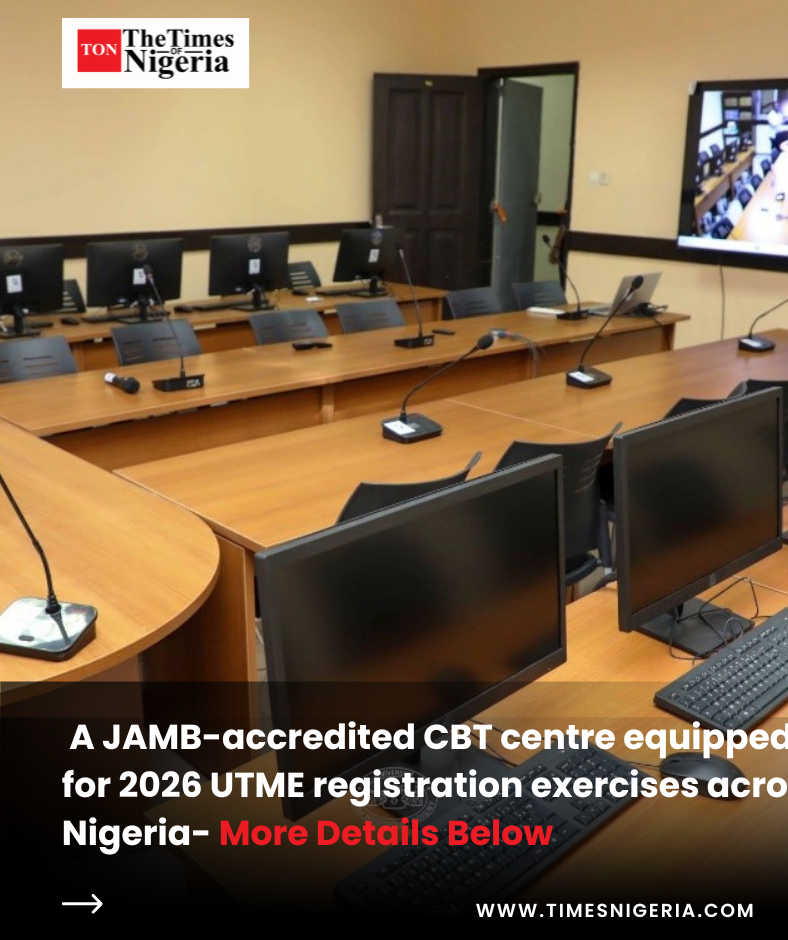
In a move that redefines how Nigeria manages its most competitive university entrance process, the Joint Admissions and Matriculation Board (JAMB) has disbursed a total of ₦1,570,671,200 to accredited Computer Based Test (CBT) centres nationwide.
The payment, tied to the 2026 Unified Tertiary Matriculation Examination (UTME) registration exercise, represents more than routine financial transfers it marks the maturation of a cashless, candidate first framework that the board has been building over several years.
Disbursed to CBT Centres
Per-Candidate Centre Fee
Exam Venues Nationwide
2026 Revenue Projection
How the New Payment System Works
According to a bulletin released by JAMB’s Public Communication Advisor, Fabian Benjamin,
the ₦700 per-candidate registration charge is no longer collected at the CBT centre itself.
Instead, JAMB bundles this fee into the cost of the ePIN at the point of purchase.
The collected sum is then remitted to individual centres on a weekly basis but only after JAMB verifies that each registered candidate is legitimate and properly captured in the system.
This structured approach ensures accountability at every stage of the registration chain.
Previously, many candidates arrived at centres only to be confronted with informal charges,
ranging from so called “printing fees” to unofficial “service charges.”
Under the new arrangement, any candidate who has purchased their ePIN is entitled to complete registration
at any JAMB-accredited CBT centre, completely free of charge.
era of exploitation at registration points is firmly behind us.

The “No View, No Pay” Accountability Policy
To keep CBT centres in check, JAMB enforces a strict policy known as “No View, No Pay.”
Under this rule, any centre whose registration activities cannot be remotely monitored in real time from JAMB’s headquarters in Abuja will have its payment withheld until the monitoring issue is resolved.
This mechanism gives the board live visibility into the operations of every centre across Nigeria, making it significantly
harder for rogue operators to exploit the system without detection or consequence.
Centres that encountered monitoring failures during the 2026 registration period reportedly
had to address those gaps before receiving their remittances a clear signal that
compliance is non negotiable.
More Centres, Better Access for Candidates
The 2026 UTME cycle also saw a remarkable expansion in infrastructure.
JAMB established over 1,000 examination venues nationwide, up from fewer than 800 in 2025.
The increase was deliberately targeted at underserved communities and high density population areas
where candidates historically had to travel long distances to reach the nearest accredited
centre.
With more venues operating within the cashless, monitored framework, the registration experience is expected to be smoother and more equitable for students
across all geographies.
What Candidates Actually Pay
Official fees for the 2026 UTME have been clearly published by the board.
Candidates registering for the UTME only without the optional mock examination pay a flat fee
of ₦7,200.
Those who wish to sit both the mock exam and the main UTME pay ₦8,700.
No additional payments should be demanded at any accredited centre, and any centre caught doing so risks sanctions and withheld remittances.

The Bigger Picture: JAMB’s Financial Scale
These developments come against a backdrop of significant financial growth at JAMB.
The board has projected internally generated revenue of ₦23.8 billion for
2026 ₦4 billion higher than its 2025 target.
Additionally, ₦6 billion is earmarked to be remitted to the Federation Account as operating surplus.
These figures place JAMB among Nigeria’s most financially active federal agencies and underscore the enormous
scale of the annual UTME exercise.
With the 2026 UTME scheduled to run from April 16 to April 25,
hundreds of thousands of candidates across Nigeria are gearing up for what may be the
most transparently managed examination cycle in the board’s history.
The ₦1.57 billion disbursement is not merely a financial milestone it is evidence that when institutional
reforms are backed by technology, policy, and political will, the people they are designed
to serve stand to gain the most.
For candidates, the message from Abuja is unambiguous: your registration fees are
accounted for, your rights at CBT centres are protected, and you are free to walk into
any accredited venue and complete your registration without paying a single extra naira.