



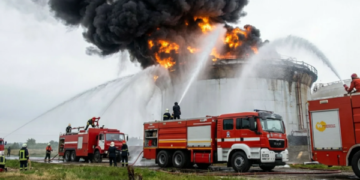



















A fresh wave of panic swept through Nigeria’s seat of power on Monday morning as the Head of Service building fire Abuja broke out, sending thick plumes of black smoke rising above the Federal Secretariat complex and forcing hundreds of civil servants to flee for safety.
The incident, which occurred just as the working day was getting underway, has once again raised serious questions about the state of fire safety in Nigeria’s federal government buildings and whether enough is being done to protect both lives and critical public records.
What Happened on Monday Morning
The Head of Service building fire Abuja was first reported at approximately 8:20 a.m. on Monday, March 9, 2026. Eyewitnesses on the scene described the moment the fire became visible thick, dark smoke billowing from one wing of the Federal Secretariat and spreading rapidly enough to send workers scrambling out of the building.
According to multiple reports, the fire broke out specifically in Section C of the Office of the Head of the Civil Service of the Federation, located within the Federal Secretariat complex in Abuja. Videos that quickly circulated on social media showed staff members rushing out of the affected section while emergency responders were being alerted.
The sight of black smoke rising over one of Nigeria’s most important administrative buildings drew large crowds and caused significant disruption to morning operations across the complex.
The Official Response
The media department of the Office of the Head of Service moved swiftly to issue a statement, confirming the incident and attempting to reassure the public that the situation was under control.
“The fire outbreak is limited to Section C of the building and is currently being attended to by emergency officials,” the office stated.
Emergency responders were dispatched to the scene and worked to contain the blaze. Authorities confirmed that staff evacuation procedures were activated promptly, with workers moved away from the affected wing while firefighters tackled the situation.
At the time of this report, the cause of the fire had not been officially confirmed, and no casualties had been announced. However, an investigation is expected to be launched to determine what sparked the outbreak.
Eyewitness Accounts: “We Just Ran”
Workers who were present at the time described scenes of confusion and fear as the fire spread. Many said they had little warning before smoke began filling corridors, leaving them with no choice but to abandon their workstations and exit the building immediately.
Several civil servants expressed concern not just about personal safety, but about the fate of documents and files housed within the affected section records that, in many cases, are irreplaceable and central to ongoing government operations.
Videos shared widely on social media captured the dramatic scenes smoke rising from windows, staff gathered in open areas outside the building, and emergency vehicles making their way to the scene.
A Troubling Pattern of Government Building Fires in Nigeria
The Head of Service building fire Abuja is not an isolated incident. It comes just days after a fire broke out at the headquarters of the Nigerian Agricultural Insurance Corporation (NAIC) on March 3, 2026, temporarily halting operations at that agency. Before that, the Federal Inland Revenue Service (FIRS) confirmed a fire on the fourth floor of its Abuja office in late 2025, which investigators suggested may have been caused by an electrical fault.
This growing pattern has triggered alarm among Nigerians, civil society groups, and opposition voices alike. Critics argue that recurring fires in government buildings often occurring during or just after sensitive administrative periods deserve more than routine explanations. Many are calling for thorough, independent investigations each time such incidents occur.
For context on Nigeria’s broader fire safety challenges, see reporting from Channels Television and Vanguard, which have documented similar incidents across federal institutions in recent years.
What Happens Next?
Authorities are expected to conduct a full assessment of the damage to Section C of the Head of Service complex before workers can return to the affected area. The priority will be ensuring the structural integrity of the building and accounting for any loss of records or equipment.
Fire safety experts have long warned that many federal government buildings in Nigeria are inadequately equipped with modern fire suppression systems, and that routine maintenance and safety drills are inconsistent across agencies. Monday’s incident may add fresh urgency to calls for a comprehensive audit of fire safety standards across all federal buildings in the FCT.
The National Emergency Management Agency (NEMA) and the FCT Fire Service are expected to be involved in the ongoing response. Updates are anticipated as investigations progress.
Final Thoughts
The Head of Service building fire Abuja is a stark reminder that fire safety in Nigeria’s public institutions remains a critical and largely unresolved challenge. Whether this turns out to be a simple electrical fault or something more sinister, the fact that yet another federal building has gone up in flames in the heart of the nation’s capital, during a working morning demands urgent answers.
Nigerians watching this story unfold are asking a question that has been asked too many times before: how many government buildings must burn before real, lasting action is taken?
We will continue to update this story as more information becomes available.