
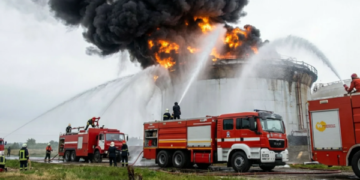



















Israel Iran war 2026
Israeli forces claimed the killing of Basij commander Gholamreza Soleimani and top security official Ali Larijani, while coordinated raids targeted military infrastructure across Tehran, Shiraz, and Tabriz.
Europe, meanwhile, firmly refused to be drawn in
Israel’s military struck at the heart of Iran’s internal security structure on Monday, claiming the targete elimination of Gholamreza Soleimani, the six year commander of the Basij paramilitary force.
Acting on what the Israel Defense Forces described as precise Military Intelligence, an Air Force strike reached what officials called a tent encampment hastily assembled by the Basij after earlier raids had already levelled several of the group’s permanent headquarters.
The deputy commander and a number of other senior Basij figures were also reportedly killed in the same operation.
“This was a joint U.S. and Israeli effort a strike in Tehran that targeted the Basij commander and around a dozen of the most senior figures in the force, people with a lot of blood on their hands.”
The Basij, a volunteer paramilitary organisation embedded within Iran’s Islamic Revolutionary Guard Corps, was founded in the wake of the 1979 revolution and has since become the regime’s primary tool for domestic repression.
Under Soleimani’s tenure, the force played a central role in crushing the wave of anti-government demonstrations that swept Iran in January, during which thousands of protesters were reportedly killed.
His death, if confirmed, would rank among the most consequential losses to Iran’s security command since the killing of Supreme Leader Ayatollah Ali Khamenei on the opening day of the current conflict.
Coordinated Raids Across Three Cities
Monday’s operations extended far beyond the capital.
Dozens of Israeli Air Force jets, guided by IDF intelligence assessments, simultaneously struck infrastructure in Tehran, Shiraz, and Tabriz in what the military described as a “wide scale” wave of coordinated raids.
In Tehran, the strikes hit command centres belonging to Iran’s Ministry of Intelligence and the Basij, alongside storage and launch facilities for drones, ballistic missiles, and air defence systems.
The southern city of Shiraz saw its internal security forces’ command hub and a ballistic missile site put out of action, while Tabriz sustained additional losses to its air defence network a development that Israeli officials said “further expands aerial superiority in the region.”
The previous day had seen the IDF carry out more than 200 strikes in the Hamadan region of western Iran, dismantling IRGC and Basij headquarters there.
The IDF also announced the destruction of what it described as the personal aircraft of the Supreme Leader, formerly stationed at Mehrabad Airport in Tehran and used by senior officials for international travel.
Since the war began on February 28, Israeli forces have logged more than 7,600 individual strikes across nearly 5,000 aerial sorties over Iranian territory.

Larijani’s Fate Claimed, Disputed, Unclear
Separately, Israeli Defence Minister Israel Katz announced that Ali Larijani secretary of Iran’s Supreme National Security Council and one of the regime’s most powerful surviving figures had also been killed in an overnight strike on a Tehran safe house.
The IDF said it was still working to confirm the outcome of that particular raid.
Iran declined to comment on either claim.
In what appeared to be an implicit denial, a handwritten note attributed to Larijani commemorating 84 Iranian sailors killed in a US naval strike circulated on his social media accounts within minutes of Katz’s announcement, though officials gave no indication of when the note was actually written.
Analysts offered caution alongside context.
Mohamad Elmasry, a professor at the Doha Institute for Graduate Studies, described the US Israeli approach as a “game of whack-a-mole,” noting that the Iranian system always produces a successor.
“There’s always another leader,” he said.
“So I don’t think this is going to suggest any kind of collapse of the Iranian regime.”
He nevertheless acknowledged the symbolic and psychological weight of the strikes, particularly given Soleimani’s personal role in the suppression of dissent.
Europe Holds the Line Against Military Involvement
As Israeli jets continued their campaign over Iranian cities, European governments gathered in Brussels to confront a different kind of pressure: a direct appeal from US President Donald Trump to deploy warships to the Strait of Hormuz.
The narrow waterway, through which roughly one-fifth of the world’s oil transits daily, has effectively been shut to US and allied shipping since Iran retaliated against the February 28 strikes.
Global crude prices have surged between 40 and 50 percent since the conflict began.
German Foreign Minister Johann Wadephul set the tone for the Brussels meeting, telling reporters that Berlin had no intention of joining any military operations.
He called on Washington and Jerusalem to be more transparent about their strategic objectives before any European government could consider a next step.
German Defence Minister Boris Pistorius was blunter still, saying flatly that the conflict was “not our war” and questioning what a handful of European frigates could realistically accomplish where the most powerful navy in the world was struggling to maintain access.
“We are particularly concerned that there is clearly no joint plan for bringing this war to a swift and convincing end.”
Chancellor Friedrich Merz echoed the concern, saying Germany shared many of the stated goals behind the US Israeli campaign but could not support open-ended military involvement without a clear endgame.
His spokesperson added that the Middle East conflict “has nothing to do with NATO” and constitutes no basis for invoking the alliance’s collective defence clause.
British Prime Minister Keir Starmer also rebuffed Trump’s direct request for naval ships, pledging that the UK “will not be drawn into the wider war,” while indicating London remained open to offering mine-hunting drone assets already positioned in the region.

The pushback was widespread. Greece, Italy, Spain, Australia, and Japan all signalled they had no immediate plans to send forces to the Gulf.
EU foreign policy chief Kaja Kallas framed the Brussels summit as an exercise in scoping what member states were actually willing to contribute, rather than a rubber-stamp for American requests.
France alone struck a somewhat more open tone, though no commitment was forthcoming.
Trump, speaking from Washington, expressed frustration with allies he said the United States had spent decades defending.
The divergence reflects a deeper strategic fracture.
European capitals fear that direct military involvement in the Strait of Hormuz could trigger Iran to move from selective disruption to an outright blockade a scenario that would send energy prices even higher and generate a new wave of migration from a region already destabilised by nearly three weeks of sustained aerial bombardment.
The Council on Foreign Relations noted that, while European governments had been moving toward greater strategic assertiveness in early 2026, the Iran conflict now presents a fresh and deeply uncomfortable test of that ambition.
Israel
Basij
Gholamreza Soleimani
Ali Larijani
Strait of Hormuz
Germany
NATO
IRGC