




















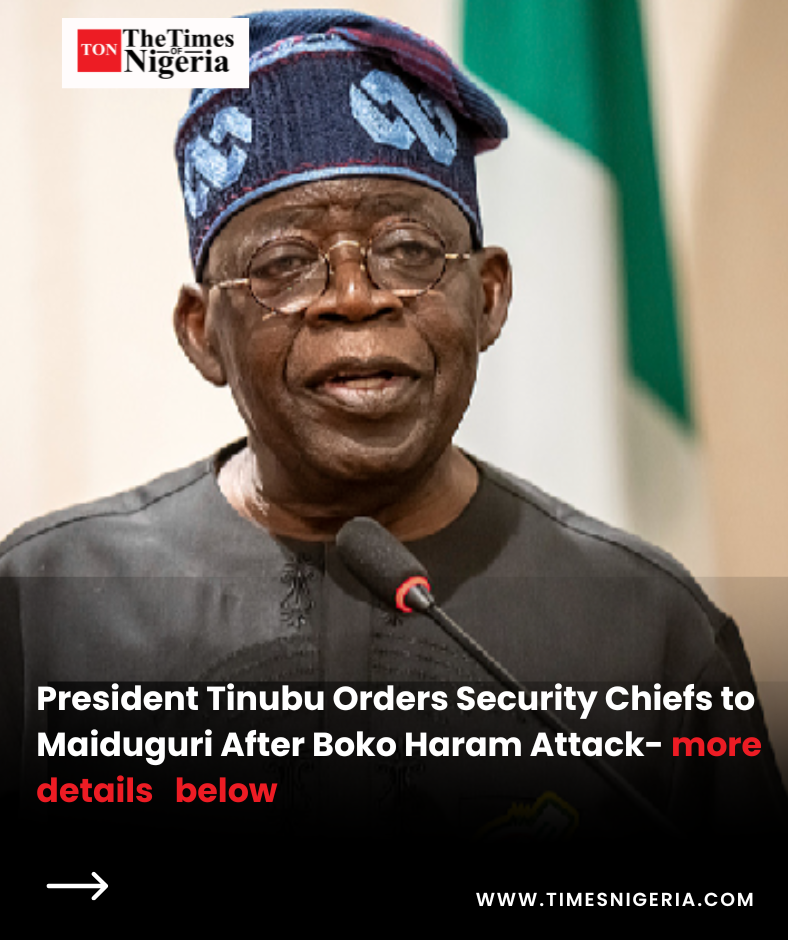
Tinubu orders security chiefs to Maiduguri Boko Haram attack
President Bola Ahmed Tinubu has issued a two pronged directive following coordinated terrorist bombings in Maiduguri ordering Nigeria’s top security chiefs to physically relocate to Borno State and mobilising emergency agencies to provide urgent care for casualties.
The statement was communicated through the President’s Special Adviser on Information and Strategy, Bayo Onanuga.
What Happened in Maiduguri
On Monday evening, multiple suicide bomb explosions ripped through three separate locations in Maiduguri, the capital of Borno State in northeastern Nigeria sending residents fleeing in panic and plunging the city into chaos. The three targeted spots were the busy Monday Market, the entrance of the University of Maiduguri Teaching Hospital, and the area near the Post Office Flyover.
The Borno State Police Command, in a statement by spokesperson ASP Nahum Daso, confirmed that 23 people were killed and 108 others sustained varying degrees of injuries.
Bomb disposal units from Police Base 13 Maiduguri were immediately deployed to sweep and secure all affected scenes, ruling out the presence of further devices.
Following the attacks, the Nigerian Army raised an alarm over intelligence indicating that additional suicide bombers may have been dispatched into Maiduguri by suspected Boko Haram operatives.
Residents have been urged to avoid crowded public spaces and report suspicious individuals to security authorities.
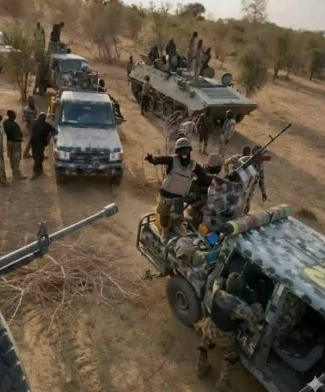
Tinubu’s Two Directives; What Onanuga Revealed
Hours after news of the blasts reached Abuja, the presidency issued an urgent response.
Presidential aide Bayo Onanuga shared details of the two immediate actions taken by President Tinubu:
Directive 1 — Security Chiefs Ordered to Maiduguri
Tinubu directed Nigeria’s top security chiefs to leave Abuja and travel immediately to Maiduguri to personally oversee and coordinate the government’s response to the attacks on the ground.
This was seen as a signal that the Federal Government was treating the incident with the highest level of urgency.
Directive 2 — Emergency Agencies Mobilised for Victims
The president also instructed emergency management bodies including the National Emergency Management Agency (NEMA) and the Borno State Emergency Management Agency (BOSEMA) to ensure all injured survivors received immediate and adequate medical attention.
Evacuations to hospitals began swiftly following the directive.
“I have directed security chiefs to move to Maiduguri to take charge of the situation. I have also directed the emergency agencies to provide proper care for the injured.”
Tinubu’s Message to Nigerians: Defiance and Condolences
In a statement shared across official government channels, President Tinubu described the events in Maiduguri as deeply troubling.
He extended personal sympathy to the families of those who lost their lives and expressed solidarity with the people of Borno State during what he acknowledged as a highly distressing period.
Rather than framing the attacks as a sign of growing insurgent strength, the president characterised them as a sign of desperation arguing that terrorist elements were lashing out precisely because they were being squeezed by the sustained pressure of Nigerian security forces.
He vowed that there would be no hiding place for those responsible.
“There is no place in Nigeria where terrorists will find safety. We will locate them, confront them, and completely defeat them. Nigeria will not succumb to fear.”
The Three Blast Sites: A Calculated Attack on Civilian Life
Security analysts note the deliberate targeting of high traffic civilian areas.
The Monday Market is one of the most frequented commercial zones in Maiduguri, drawing thousands of traders and buyers daily.
The University of Maiduguri Teaching Hospital gate is a point of high pedestrian flow, while the Post Office Flyover sits at a key junction in the city.
Emergency responders from NEMA and BOSEMA worked rapidly to transport the wounded to nearby medical facilities.
Authorities confirmed that calm had been largely restored to the city by Tuesday, with a heavy increase in security patrols and surveillance across all major urban zones.
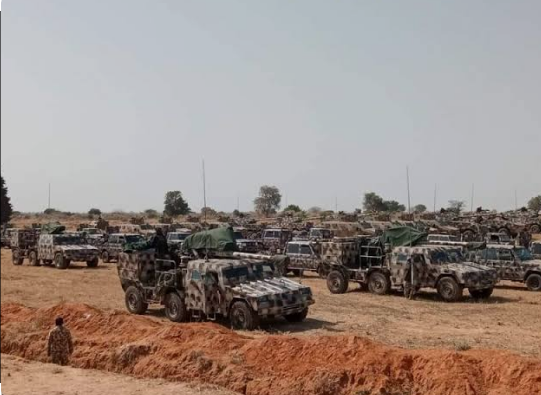
Background: Maiduguri at the Heart of Nigeria’s Insurgency
Maiduguri has been the epicentre of Nigeria’s long running insurgency since 2009, when Boko Haram launched its violent campaign to establish an Islamist state across the region.
The group, and its splinter faction the Islamic State West Africa Province (ISWAP), have historically targeted mosques, markets, military positions, and other public spaces frequently deploying suicide bombers, sometimes women concealing explosives beneath religious clothing.
While violence had appeared to decline from its peak a decade ago a period that saw mass kidnappings, village massacres, and the brief seizure of entire local government areas attacks have continued to recur.
The region’s porous borders with Niger, Cameroon, and Chad have remained a persistent challenge for Nigerian security forces, with insurgents able to regroup and resupply through the Sahel corridor.
Borno State Governor Babagana Zulum has consistently flagged the threat of insurgent regrouping around the Tumbus area of Lake Chad and the Mandara Hills within the Sambisa Forest.
The state has spent an estimated ₦7.7 billion over 21 months on rehabilitating repentant fighters through its Disarmament, Demobilisation and Reintegration programme yet bombings have continued to occur.
Security Response: Nationwide Deployments Following the Attack
In addition to the security chiefs’ relocation to Borno, authorities announced the mass deployment of tactical squads across multiple states in the wake of the attack.
Over 16,700 operatives were positioned in worship centres, markets, and urban hubs across Borno, Kogi, Edo, Bauchi, Plateau, Kano, Abia, and several other states a reflection of the government’s concern that the Maiduguri strike could be part of a broader wave of planned attacks.
Police Explosive Ordnance Disposal teams continued to conduct sweeps in and around Maiduguri to ensure no undetonated devices remained in the city.
A joint security presence comprising military personnel, police tactical units, and other agencies was maintained across all blast sites and surrounding neighbourhoods.
A Pattern of Attacks: The North East Under Siege
The Maiduguri bombings are not isolated.
Just days before, in early March 2026, insurgents launched a coordinated night assault on Nigerian Army artillery positions in Ngoshe, a border community in Gwoza Local Government Area.
The Nigerian Air Force conducted precision airstrikes on the withdrawal routes of fleeing terrorists, neutralising dozens of operatives.
President Tinubu also condemned that attack and extended condolences to families of soldiers and civilians killed.
Earlier, a Christmas Eve 2025 suicide bombing at the Al-Adum Mosque in Gamboru Market, Maiduguri carried out during evening prayers killed several worshippers and prompted a nationwide security surge.
These incidents, taken together, paint a picture of a re-energised insurgency pushing back against years of military attrition.
“ISWAP and Boko Haram are terrorists getting support internationally, and looking at our porous borders, they remain infiltrated through the Sahel, which is our major problem. We need air support…”
The Road Ahead: Defeating Terror Without Letting Guard Down
Human rights observers and security researchers have noted that the Nigerian military has repeatedly declared Boko Haram defeated over the years only for attacks to resume.
The resurgence of suicide bombings in 2024 and into 2026, after a period of relative quiet, has renewed questions about whether ground gains by the military are translating into lasting civilian protection.
President Tinubu’s administration has maintained that its security forces are applying consistent pressure on insurgent groups.
The latest directives deploying security chiefs and mobilising emergency services signal a government that is at minimum responding visibly and swiftly to each major incident.
Whether those responses translate into a durable reduction in violence will likely define the security narrative of Nigeria’s northeast for months to come.
For now, the people of Maiduguri who have endured over a decade and a half of bomb blasts, displacement, and loss are once again mourning their dead, recovering their wounded, and watching closely to see if this time, the government’s words will be matched by lasting results on the ground.