
























Nigerian Govt Exempts Education, Agric Candidates From UTME
The Nigerian government has announced a major policy shift in tertiary admissions, exempting candidates seeking to study Education and non-engineering Agriculture courses from sitting for the Unified Tertiary Matriculation Examination (UTME).
The landmark decision, unveiled on Monday, May 11, 2026, during the annual admission policy meeting organised by the Joint Admissions and Matriculation Board (JAMB) in Abuja, aims to address shortages in critical sectors and create easier pathways into teacher training and agricultural programmes.
Minister of Education, Tunji Alausa, disclosed that candidates with a minimum of four credit passes in relevant O’Level subjects will now be eligible for direct admission into Colleges of Education (NCE programmes) and National Diploma (ND) programmes in non-technology agriculture-related courses without writing the UTME.
According to the minister, exempted candidates must still register with JAMB for proper documentation and processing.
Their academic credentials will undergo screening, verification, and certification before admission letters are issued through the Central Admissions Processing System (CAPS).
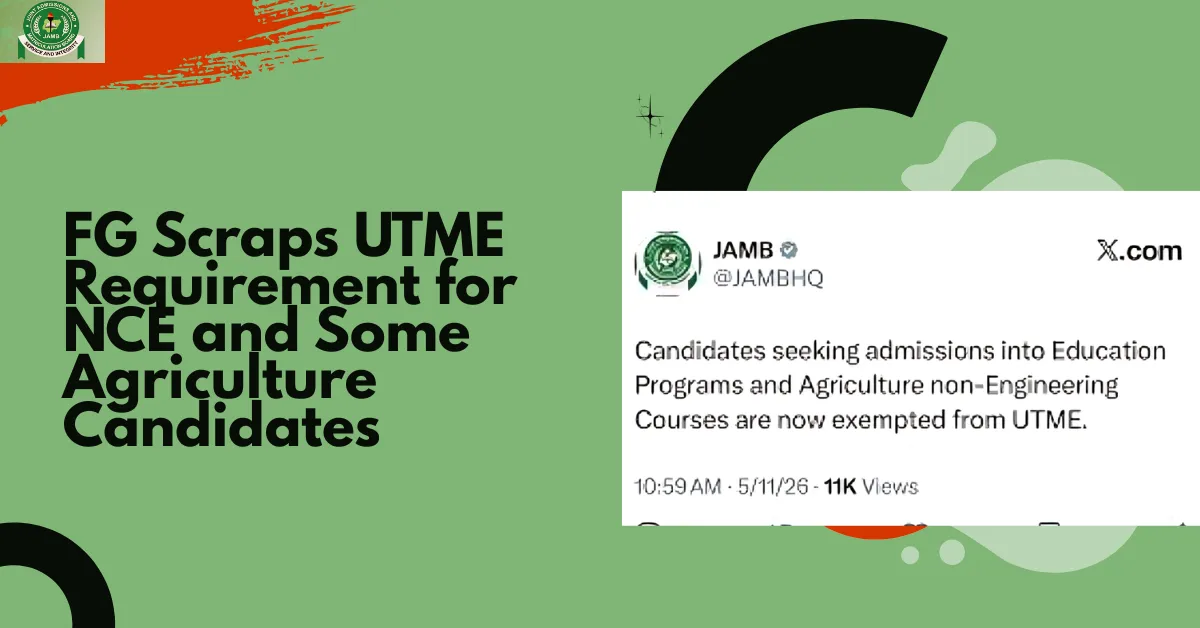
JAMB confirmed the development via its official X handle, stating: “Candidates seeking admissions into Education Programs and Agriculture non-Engineering Courses are now exempted from UTME.”
The exemption applies specifically to all Nigeria Certificate in Education (NCE) programmes and National Diploma (ND) programmes in non-technology agricultural and agriculture-related fields.
It however does not cover engineering-related agriculture courses or other university degree programmes.
Nigeria has long faced acute shortages of qualified teachers and skilled agricultural manpower.
This policy is seen as a strategic move to encourage more young Nigerians to pursue careers in education and agriculture by lowering entry barriers.
The annual JAMB policy meeting traditionally sets admission guidelines, cut-off marks, and procedures for universities, polytechnics, and colleges of education nationwide.
While limited exemptions (such as for Direct Entry candidates) have existed before, this is regarded as one of the broadest waivers in recent years.

The new policy is expected to boost enrolment in Colleges of Education and agricultural programmes, and reduce pressure on the UTME system. Others include addressing teacher shortages, especially at basic education levels, and supporting federal government efforts toward food security and agricultural modernisation.
However, some education stakeholders have expressed concerns about potential quality implications, arguing that maintaining rigorous standards remains essential even with relaxed entry requirements.
Tunji Alausa emphasised that the exemption aligns with broader reforms aimed at making tertiary education more accessible while upholding necessary academic safeguards through credential verification.