


















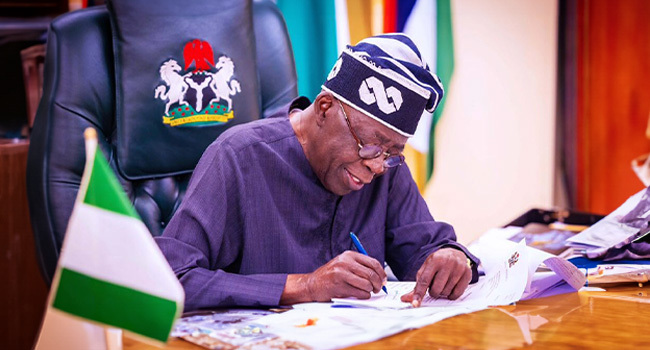
Tinubu signs 2026 budget law and with a stroke of the pen,
President Bola Ahmed Tinubu has officially set Nigeria’s fiscal course for 2026,
signing a landmark ₦68.32 trillion Appropriation Act into law today,
April 17, 2026.
In the same action, the President also signed a companion bill extending the implementation
period for the 2025 budget from March 31, 2026 to June 30, 2026
a move that carries enormous implications for government contractors, Ministries,
Departments and Agencies (MDAs), and ordinary Nigerians waiting on government projects.
This is Nigeria’s biggest budget in history and understanding what is in it,
why it grew so dramatically from the original proposal, and what it means for the
average Nigerian is more important now than ever.
Here is your complete breakdown.
1. Breaking: Tinubu Signs 2026 Budget Law — Nigeria’s Biggest Ever

President Bola Tinubu has signed into law the 2026 Appropriation Bill of ₦68.32 trillion,
while also approving an extension of the 2025 budget implementation period to June 30, 2026.
The signing took place on Thursday, April 17, 2026, at the State House in Abuja,
and was confirmed in an official statement released to the public.
The National Assembly had officially passed the 2026 Appropriation Bill approving
a total expenditure of ₦68.323 trillion a strategic upward revision of over ₦9.09 trillion
from the initial ₦58.47 trillion proposal submitted by President Tinubu.
The revised figure reflects what the Presidency described as the need to accommodate
critical legacy commitments and accelerate development in key sectors.
Read the original breaking report at
Sahara Reporters — Tinubu Signs ₦68.32trn 2026 Budget Law.
2. How Big Is the 2026 Budget? The Full Size and Complete Breakdown
To put the size of this budget in perspective:
₦68.32 trillion is roughly 17% larger than Nigeria’s entire GDP a decade ago.
It is also ₦9.09 trillion larger than what Tinubu originally proposed to the
National Assembly in December 2025.
The ₦68.32 trillion budget earmarks ₦4.799 trillion for statutory transfers and
₦15.8 trillion for debt service, allocates ₦15.4 trillion to recurrent expenditure,
and ₦32.2 trillion to the Development Fund for Capital Expenditure.
| Budget Component | Allocation (₦ Trillion) | % of Total Budget |
|---|---|---|
| Capital Expenditure (CAPEX) | ₦32.287 trillion | ~47% |
| Recurrent Expenditure | ₦15.4 trillion | ~23% |
| Debt Service | ₦15.8 trillion | ~23% |
| Statutory Transfers | ₦4.799 trillion | ~7% |
| Legacy Debt Resolution (2025 Carryover) | ₦5.71 trillion | ~8% |
| TOTAL | ₦68.32 trillion | 100% |
With capital expenditure accounting for about 50 per cent,
the 2026 budget underscores the administration’s continued commitment to economic stability,
national security, infrastructure development, and inclusive growth.
3. Key Allocations — Where Is Your Money Going in 2026?
The revised fiscal framework follows a formal request from the President to accommodate
critical legacy commitments, with funds specifically earmarked to accelerate development in the
transportation and health sectors, while providing essential financial boosts to the
judiciary and addressing outstanding national obligations.
Capital Projects — ₦32.287 Trillion
The budget allocates a staggering ₦32.287 trillion to Capital Projects,
representing nearly half of the total expenditure — reinforcing the administration’s focus on
long-term economic stimulation over consumption.
Legacy Debt Resolution — ₦5.71 Trillion
A critical ₦5.71 trillion is dedicated to regularising capital obligations carried over
from 2025, ensuring contractors and developers are paid for completed works.
This is a direct acknowledgement that past projects were funded but not fully executed or paid for —
and the 2026 budget is designed to close those gaps once and for all.
Debt Service — ₦15.8 Trillion
Nigeria continues to carry a heavy debt burden.
₦15.8 trillion nearly a quarter of the entire budget goes directly to servicing existing debts.
This figure remains one of the most discussed and debated aspects of Nigeria’s fiscal management,
with critics arguing it leaves too little for productive investment.
For full budget implementation data and Nigeria’s fiscal history, visit the
Nigeria Budget Office of the Federation — Official Website.
4. Why Tinubu Extended the 2025 Budget to June 2026
One of the most significant and controversial aspects of today’s signing is the
extension of the 2025 budget implementation period.
Tinubu also signed the bill extending the implementation period for the 2025 budget
from March 31, 2026, to June 30, 2026.
This was done to prevent ongoing capital projects from being abandoned mid-completion
simply because the fiscal year had ended.
To ensure value for money and the successful delivery of existing infrastructure,
the National Assembly approved an extension for the capital component of the 2025 budget,
shifting the implementation deadline from March 31 to June 30, 2026,
allowing MDAs to complete ongoing projects without fiscal interruption.
In practical terms, this means Nigeria is now officially running two budgets simultaneously
the 2026 Appropriation Act and the extended capital component of the 2025 budget
through June 30, 2026.
Related: Nigeria 2025 Budget — Full Breakdown, Key Priorities & Implementation Challenges
5. Nigeria’s Overlapping Budget Problem — How Did We Get Here?
President Bola Tinubu had fallen short of his March 31 target to end Nigeria’s
overlapping budget cycles, after the National Assembly approved an extension of
the 2025 capital budget to June 30.
This is not a new problem. Under the current administration,
the National Assembly has approved multiple overlapping budgets. For instance, in 2024,
Nigeria operated three budgets simultaneously the ₦21.8 trillion 2023 budget,
the ₦2.17 trillion 2023 supplementary budget, and the ₦28.7 trillion 2024 appropriation.
The trend continued in 2025, when the capital component of the 2024 budget,
which should have ended in December 2024, was extended twice
first to June 2025 and then to December 2025.
If the President’s request to extend and re-enact the 2025 budget is approved
while the 2026 budget is also in force, Nigeria will effectively be operating two budget cycles simultaneously
continuing the very problem the president has described as a key reason for the fiscal reset exercise.
Why Does This Keep Happening?
The issue of multiple budget implementations and continuous extension of capital
components has long been a source of concern, with the Federal Government often with the support
of the National Assembly justifying such extensions as necessary for project completion.
6. Nigeria’s Economy in 2026 — The Numbers Behind the Budget
Understanding why Tinubu signs 2026 budget law at this moment requires
looking at where Nigeria’s economy stands right now.
The numbers, while not perfect, paint a cautiously optimistic picture.
| Economic Indicator | Latest Figure |
|---|---|
| GDP Growth Rate (Q3 2025) | 3.98% (up from 3.86% in Q3 2024) |
| Inflation (November 2025) | 14.45% (down from 24.23% in March 2025) |
| External Reserves | ~$47 billion (7-year high) |
| 2025 Revenue (Q3) | ₦18.6 trillion (61% of target) |
| 2025 Expenditure (Q3) | ₦24.66 trillion (60% of target) |
| 2025 Capital Budget Released (Q3) | ₦3.10 trillion (only 17.7% of capital budget) |
President Tinubu highlighted that Nigeria’s economy grew by 3.98 per cent
in the third quarter of 2025 compared to 3.86 per cent in the same period of 2024,
while inflation moderated for eight consecutive months; he also cited improved oil production,
expanded non-oil revenues through better tax administration, renewed investor confidence,
and external reserves rising to a seven-year high of about US$47 billion.
However, the fact that only ₦3.10 trillion about 17.7% of the 2025 capital budget
was released as of Q3, reflecting the emphasis on completing priority 2024 capital
projects during the transition period, shows that actual budget execution
continues to significantly lag behind appropriations.
7. Key Budget Assumptions: Oil Price, Exchange Rate & Revenue Targets
Every Nigerian budget is built on a set of economic assumptions.
If those assumptions prove wrong as they often do the entire fiscal plan comes under serious strain.
Here are the 2026 budget’s key benchmarks:
| Parameter | 2026 Assumption |
|---|---|
| Crude Oil Benchmark Price | $64.85 per barrel |
| Daily Oil Production | 1.84 million barrels per day |
| Exchange Rate | ₦1,400 per US Dollar |
| Total Expected Revenue | ₦34.33 trillion |
| Budget Deficit | ₦23.85 trillion (4.28% of GDP) |
The budget records a deficit of ₦23.85 trillion equivalent to 4.28 per cent of
Gross Domestic Product highlighting both the scale of Nigeria’s development needs and the
administration’s commitment to balancing fiscal sustainability with capital-led economic expansion.
For independent analysis of Nigeria’s budget and economic outlook, read
Nairametrics — Nigeria’s No. 1 Business & Financial Intelligence Platform.
8. What Tinubu Is Demanding From MDAs in 2026 — No Excuses
With the signing done, President Tinubu has made it abundantly clear that the era of
budget padding, poor execution, and leakages must end in 2026.
President Tinubu directed MDAs to ensure disciplined, transparent, and efficient
utilisation of allocated resources, with a strong emphasis on value for money and timely project delivery.
He re-assured Nigerians of his administration’s resolve to deepen fiscal reforms,
enhance revenue generation, and prioritise investments that will stimulate economic growth,
create jobs, and strengthen social protection mechanisms.
In his December 2025 budget presentation which set the foundation for today’s signing
Tinubu declared: “We are terminating the habit of running three budgets in one inflow.
By March 31, 2026, all capital liabilities from previous years will be fully funded and closed.
From April, Nigeria will operate on a single budget backed by a single revenue cycle
no overlaps, no excuses, no rollovers.”
The extension of the 2025 budget to June 2026, however, shows that achieving this goal
has proven more complex than originally planned
a reality Tinubu’s administration appears to acknowledge candidly.
Also see: Tinubu’s Economic Reforms — Full 2025 Review: What Worked and What Didn’t
9. What the 2026 Budget Signing Means for Everyday Nigerians
Now that Tinubu signs 2026 budget law into effect, what does it practically
mean for the average Nigerian on the street?
Here is the honest breakdown:
✅ The Positives
- 🏗️ More infrastructure spending — ₦32.2 trillion in capital expenditure means
more roads, bridges, schools, hospitals, and power projects are expected to be funded - 💊 Health sector boost — specific allocations to accelerate healthcare development
- ⚖️ Judiciary funding — improved financial support for Nigeria’s courts
- 🏭 Contractor payments — ₦5.71 trillion in legacy debt resolution means
thousands of Nigerian contractors who completed 2025 projects will finally be paid - 📉 Declining inflation — with inflation down to 14.45% from 24.23%,
the cost of living pressure is easing — slowly but surely
The Concerns
- ₦15.8 trillion debt service — nearly a quarter of every naira budgeted
goes to paying debt, not building Nigeria - ₦23.85 trillion deficit — Nigeria must borrow heavily to fund this budget,
raising serious questions about long-term debt sustainability - Overlapping budgets — despite Tinubu’s promise of a clean single-budget cycle,
Nigerians are again living under two simultaneous budgets until June 2026 - Poor historical execution — with only 17.7% of the 2025 capital budget
released by Q3, can Nigeria actually spend ₦32.2 trillion in CAPEX in 2026?
For independent analysis, visit
The Guardian Nigeria — Authoritative Nigerian News & Political Analysis.
📌 Related: Nigeria’s National Debt in 2026 — How Much Do We Owe and Can We Pay?
10. Conclusion: A Historic Signing — But Execution Is Everything
The moment Tinubu signs 2026 budget law into effect marks a significant
milestone in Nigeria’s fiscal calendar — and a crucial test of whether the government can
translate ambitious numbers into real, tangible improvements in the lives of
over 220 million Nigerians.
The ₦68.32 trillion budget is bold by any measure.
With capital expenditure accounting for about 50 per cent,
the 2026 budget underscores the administration’s commitment to economic stability,
national security, infrastructure development, and inclusive growth,
with allocations reflecting a strategic balance between statutory obligations,
debt-servicing, recurrent expenditure, and capital investments critical to
driving productivity and improving quality of life for Nigerians.
But Nigerians have heard ambitious promises before.
The difference in 2026 will not be measured by what was appropriated
it will be measured by what was actually built, delivered, and felt by the people.
Follow our blog for ongoing updates on budget implementation,
economic reforms, and what the 2026 appropriation means for your industry, your family,
and your future.