























UK visa fee for Nigerians
The United Kingdom has officially announced a revised UK visa fee for Nigerians, with the new fee structure set to come into effect on April 8, 2025.
The announcement has generated widespread attention among Nigerian travellers, students, workers, and families planning to visit or relocate to the UK.
With thousands of Nigerians applying for various categories of British visas every year, this development carries significant implications for a large number of applicants across the country.
What Happened: UK Announces Updated Visa Fee for Nigerians
The British government, through its official immigration channels, confirmed that new visa processing fees will apply to applications submitted by Nigerian nationals beginning April 8, 2025.
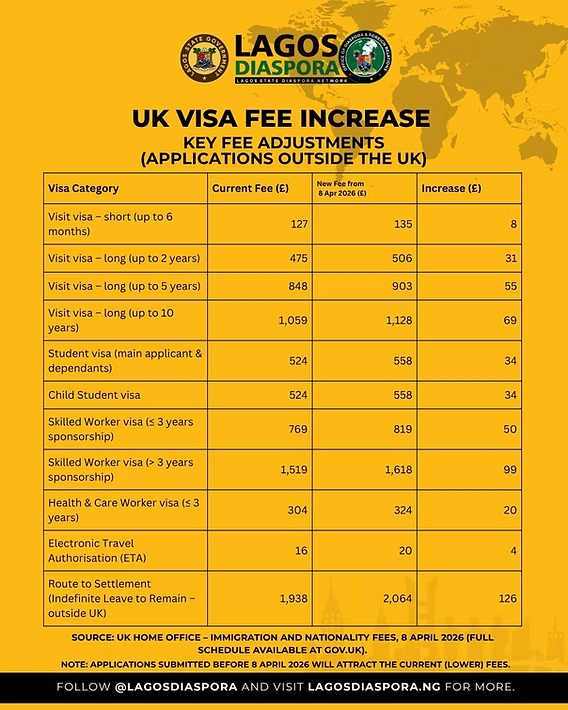
The updated UK visa fee for Nigerians covers multiple visa categories, including visitor visas, student visas, skilled worker visas, and family reunion visas.
According to reports, the fee adjustment is part of a broader review of immigration costs that the UK government undertakes periodically to reflect administrative and operational expenses.
The announcement was made public through the UK Visas and Immigration (UKVI) service, which processes all visa applications from Nigeria.
The revised fees are expected to affect both new applicants and those seeking visa extensions or changes in immigration status.
Nigerian applicants are being advised to review the updated fee schedule carefully before submitting their applications to avoid delays or rejections due to incorrect payments.
Details of the New UK Visa Fee for Nigerians
While the exact figures vary depending on the visa category, the new UK visa fee for Nigerians represents a noticeable increase compared to previous rates. Visitor visa fees, which are among the most commonly applied for categories by Nigerians, are expected to see an adjustment.
Similarly, fees for Tier 2 and Tier 5 work visas, student visas, and settlement visas have also been revised upward.
In addition to the base application fee, Nigerian applicants are also required to pay the Immigration Health Surcharge (IHS), which grants access to the UK’s National Health Service (NHS) during their stay.
The IHS fee has also seen periodic increases in recent years, adding to the overall cost of obtaining a UK visa.
For many Nigerian families and individual applicants, these cumulative costs represent a substantial financial commitment.
It is also worth noting that the UK visa fee for Nigerians does not include additional costs such as biometric enrollment fees, document translation services, courier charges, and travel expenses to visa application centres located in Lagos and Abuja.
When all associated costs are factored in, the total expense of applying for a UK visa can be significantly higher than the base application fee alone.

Reactions from Nigerian Applicants and Travel Community
The announcement of the revised UK visa fee for Nigerians has prompted mixed reactions from various quarters.
Many prospective applicants have expressed concern over the rising cost of obtaining a UK visa, noting that the fees are becoming increasingly difficult to afford for average Nigerian citizens.
Social media platforms have been flooded with commentary from Nigerians who feel that the repeated increases in visa fees are creating barriers to legitimate travel and migration.
Travel consultants and immigration lawyers based in Nigeria have also weighed in on the development.
Several experts have advised applicants to begin their visa processes as early as possible to take advantage of current fee structures before the April 8 deadline.
Others have recommended that applicants carefully assess whether their travel plans justify the financial investment, particularly in cases where visa outcomes are uncertain.
Some members of the Nigerian diaspora in the UK have expressed solidarity with those affected, calling on the British government to consider more affordable visa options for applicants from developing nations.
Advocacy groups have also urged the Nigerian government to engage in diplomatic discussions with the UK about reciprocal visa arrangements that could ease the financial burden on Nigerian travellers.
UK Government’s Position on the Fee Adjustment
The British government has maintained that visa fee adjustments are a routine part of managing the immigration system.
According to official statements, the fees are designed to ensure that the visa processing infrastructure remains adequately funded and that the quality of service provided to applicants is maintained at a high standard.
The UK Home Office has also pointed out that visa fees contribute to the broader immigration enforcement and border security apparatus.
Officials have further noted that the UK remains committed to welcoming legitimate travellers, students, and skilled workers from Nigeria.
Despite the increase in the UK visa fee for Nigerians, the British government has emphasized that Nigerian continues to be one of the top source countries for UK visa applications, reflecting the strong ties between the two nations.
The UK has also highlighted various scholarship programmes, trade initiatives, and cultural exchange opportunities that remain available to Nigerian nationals.
Broader Concerns About Immigration Costs and Access
The updated UK visa fee for Nigerians arrives at a time when global immigration costs are rising across the board.
Several Western nations have increased their visa fees in recent years, citing inflation, enhanced security screening requirements, and the need to fund digital transformation of immigration systems.
For Nigerian applicants, who already face one of the highest visa refusal rates among applicant nationalities, the increased fees add another layer of difficulty to an already challenging process.
There are also broader questions about equity and access in the global immigration system.
Critics argue that high visa fees disproportionately affect applicants from lower income countries, effectively creating a two tier system in which only the financially privileged can afford to travel or migrate.
This debate is not unique to the UK Nigeria corridor but is part of a wider global conversation about the fairness of immigration policies.
For Nigerian students, in particular, the rising cost of UK visas, combined with increasing tuition fees and living expenses, has prompted many to explore alternative study destinations such as Canada, Ireland, and several European countries that offer more affordable pathways to international education.
What Nigerian Applicants Should Do Now
Given the impending changes to the UK visa fee for Nigerians, prospective applicants are encouraged to take the following steps:
1. Review the updated fee schedule: Visit the official UK government website to confirm the exact fees applicable to your visa category before submitting your application.
2. Apply before April 8 if possible: Applicants who are ready to submit their applications may benefit from doing so before the new fees take effect, potentially saving a significant amount of money.
3. Prepare comprehensive documentation: Ensuring that your application is complete and well documented can help reduce the risk of refusal, which would result in the loss of the application fee.
4. Consult a qualified immigration adviser: Professional guidance can help you navigate the application process more efficiently and improve your chances of success.
5. Budget for all associated costs: Remember that the visa fee is only one component of the total cost.
Factor in biometric fees, health surcharge payments, travel to application centres, and other incidental expenses.
Conclusion: Navigating the New UK Visa Fee Landscape
The announcement of the new UK visa fee for Nigerians effective April 8, 2025, is a significant development that will affect thousands of applicants across the country.
While the fee increase reflects the UK government’s broader immigration funding strategy, it undeniably adds to the financial pressure faced by Nigerian travellers and migrants.
As the deadline approaches, it is crucial for applicants to stay informed, plan ahead, and make well-considered decisions about their UK travel and immigration plans.
The relationship between Nigeria and the United Kingdom remains strong, built on decades of historical, cultural, and economic ties.
Despite the challenges posed by rising visa costs, the flow of people, ideas, and commerce between the two nations is expected to continue.
Nigerian applicants who are well prepared and adequately informed will be in the best position to navigate the evolving visa landscape successfully.