












Court Subpoenas INEC Chairman Over Tinubu’s 1999, 2023 Election Records Amid 2027 Disqualification Suit
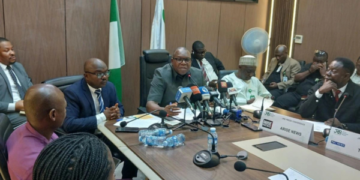
A fresh legal development has intensified the controversy surrounding President Bola Ahmed Tinubu’s eligibility for the 2027 presidential election, following a Federal High Court order directing the Chairman of the Independent National Electoral Commission (INEC), Professor Joash Ojo Amupitan, to produce the president’s electoral records from 1999 and 2023.
The order was made in Abuja during the ongoing criminal trial of human rights activist and African Action Congress (AAC) presidential candidate, Omoyele Sowore, over his description of Tinubu as a criminal.
According to reports published on Monday, November 9, 2026, the court granted the defence’s request to subpoena Amupitan as a witness and compel him to produce documents submitted by Tinubu to INEC during the two elections.
The documents reportedly include Tinubu’s Form CF001 for the 1999 Lagos State governorship election, an affidavit relating to lost certificates, and his Form CF001 for the 2023 presidential election.
The subpoena is connected to the criminal proceedings in suit number FHC/CR/484/2025, before Justice Mohammed Garba Umar of the Federal High Court, Abuja.
The development is significant because the documents could also become relevant to a separate legal battle challenging Tinubu’s eligibility to contest the 2027 presidential election.
Atiku, ADC challenge Tinubu’s 2027 eligibility over alleged NYSC certificate forgery
The subpoena comes against the backdrop of a separate suit instituted by former Vice-President Atiku Abubakar and the African Democratic Congress (ADC), seeking to prevent Tinubu and the APC from participating in the 2027 presidential election over an alleged forged National Youth Service Corps (NYSC) discharge certificate.
The case, marked FHC/ABJ/CS/1888/2026, centres on allegations that a certificate submitted to INEC in support of Tinubu’s presidential candidacy bears the name “Tinubu Bola Adekunle”, rather than “Bola Ahmed Tinubu”.
Atiku and the ADC contend that the alleged discrepancy raises questions about the authenticity of the certificate and whether the president submitted a forged document to the electoral commission.
They are asking the Federal High Court to determine whether Tinubu violated the constitutional provisions governing presidential eligibility and whether he and the APC should be disqualified from the 2027 election if the allegations are established.
The plaintiffs are relying principally on Section 137(1)(j) of the 1999 Constitution, which provides that a person is not qualified for election as president if he has presented a forged certificate to INEC.
The suit also seeks access to relevant electoral records, including Tinubu’s nomination documents, to establish the facts surrounding the allegations.
In September 2026, the court granted Atiku and the ADC permission to serve Tinubu through the APC after their attempts at personal service were unsuccessful.
The plaintiffs subsequently sought permission to amend their originating processes to correct filing errors and provide clearer copies of exhibits supporting their allegations.
Following arguments by the parties, the court fixed November 20, 2026, to rule on the application to amend the suit. This means the substantive allegations are yet to be finally determined.
What Section 137(1)(j) of the Constitution provides
Section 137(1)(j) of the Nigerian Constitution specifically addresses the presentation of forged certificates to INEC.
The provision states that a person shall not be qualified for election to the office of president if the person has presented a forged certificate to the electoral commission.
However, establishing a discrepancy in names or information contained in electoral documents does not automatically amount to proof of forgery.
The court would have to examine the documents, the circumstances surrounding their issuance and submission, and the applicable legal requirements before reaching a determination.
Consequently, the allegation against Tinubu remains a matter for judicial determination, not an established finding of criminal wrongdoing or constitutional disqualification.
Sowore’s trial takes another turn
Meanwhile, the subpoena emerged during Monday’s proceedings in Sowore’s criminal trial, which arose from his social media posts describing President Tinubu as a criminal.
The court had earlier rejected Sowore’s attempt to subpoena a lawyer representing the Department of State Services (DSS), citing the principle of legal professional confidentiality.
However, the judge subsequently granted the defence’s request to subpoena INEC Chairman Amupitan and APC chieftain Joe Igbokwe as proposed witnesses.
The court adjourned the proceedings until November 11, 2026, for the appearance of the subpoenaed witnesses.
Sowore has maintained his position on the case, describing the prosecution as an attempt to intimidate him and restrict freedom of expression. Channels Television +2
Does the subpoena automatically threaten Tinubu’s 2027 ambition?
Although the subpoena could provide access to records relevant to the separate eligibility dispute, it does not mean that Tinubu has been disqualified or that the Federal High Court has ruled against his eligibility.
The subpoena was issued in Sowore’s criminal trial, not in Atiku and the ADC’s separate 2027 disqualification case.
Any attempt to use documents obtained through the subpoena in the separate proceedings would still be subject to applicable evidential and procedural rules.
The outcome of Atiku and the ADC’s case will depend on the evidence presented, the legal arguments of the parties and the court’s interpretation of the Constitution.
For now, the November 20 ruling on the application to amend the originating processes and the November 11 proceedings in Sowore’s trial are important dates to watch.
The unfolding legal battles could have significant implications for the 2027 presidential election, particularly if the courts are eventually asked to determine whether the documents submitted by Tinubu satisfy the constitutional requirements for presidential eligibility.
Tinubu, Atiku, ADC, INEC and the 2027 presidential election are therefore at the centre of an increasingly consequential legal dispute.