




















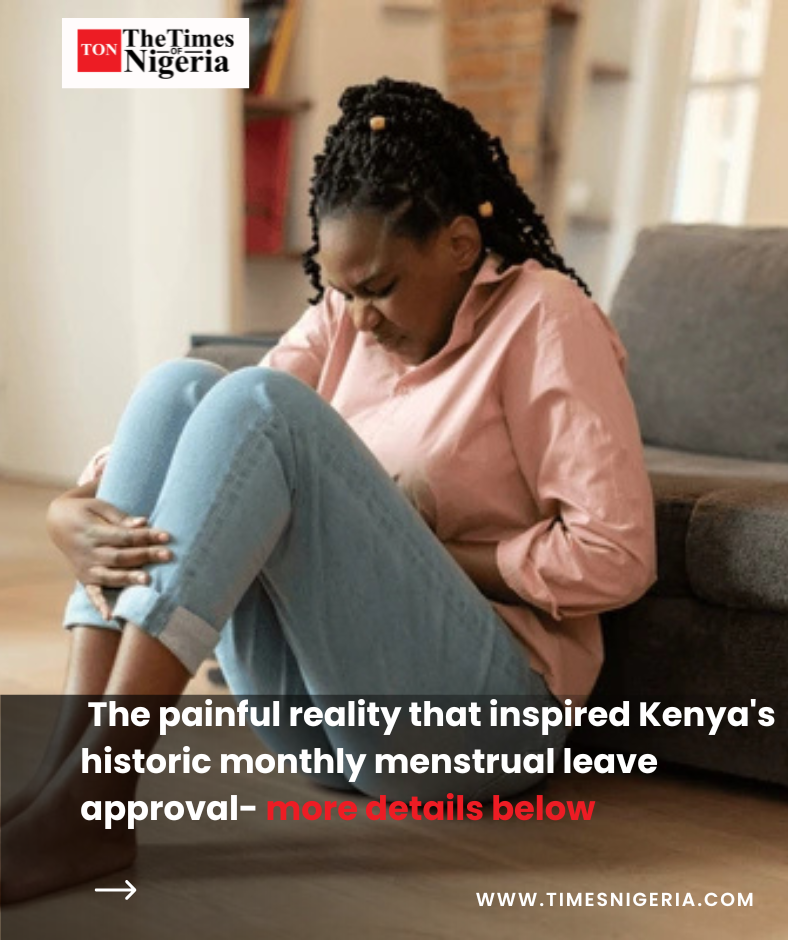
In a landmark decision that has captured global attention, Kenya’s monthly menstrual leave has officially been approved by the country’s authorities, granting women one paid day off per month to manage menstrual discomfort.
The policy marks a significant step forward in recognising women’s health needs within the formal workplace and positions Kenya as one of the few African nations to take such a progressive stance on menstrual health rights.
The Kenya monthly menstrual leave policy entitles female employees to one designated day off each month without the requirement to provide a medical certificate or formal justification.
This means women experiencing painful or debilitating menstrual symptoms will no longer be forced to choose between their health and their jobs.
The approval of this policy follows growing advocacy from women’s rights groups, healthcare professionals, and labour organisations who have long argued that menstruation is a legitimate health concern that deserves formal workplace recognition.
The decision places Kenya alongside a small but growing list of countries worldwide, including Japan, Indonesia, Zambia, and South Korea, that have already institutionalised some form of Kenya monthly menstrual leave or similar menstrual health protections in their labour frameworks. For many Kenyan women, this is not just a policy; it is a validation of a lived experience that has too often been dismissed or stigmatised in professional settings.
Why This Decision Matters for Women Across Africa
The approval of Kenya’s monthly menstrual leave sends a powerful message across the African continent at a time when gender equality in the workplace remains a deeply contested issue.
Women’s rights advocates have welcomed the policy as a critical acknowledgement that biological realities should not be a barrier to professional participation.
According to health experts, a significant percentage of women experience dysmenorrhea, a medical condition characterised by severe menstrual cramps that can make it physically impossible to perform daily work duties. Critics of the policy, however, argue that it could inadvertently lead to workplace discrimination, with some employers potentially reluctant to hire women for fear of productivity losses.
Labour analysts warn that for the Kenya monthly menstrual leave policy to succeed, it must be accompanied by strong anti-discrimination enforcement mechanisms and clear legal protections to prevent employers from penalising women who exercise this right.
Public and Government Reaction
The announcement has triggered a wave of reactions both within Kenya and internationally.
Many Kenyan women took to social media to express relief, gratitude, and cautious optimism, describing the policy as long overdue.
Some shared personal accounts of struggling through painful menstrual cycles while being expected to maintain full workplace performance without any institutional support.
Government officials who championed the Kenya monthly menstrual leave initiative have emphasised that it aligns with Kenya’s broader commitment to gender equity and improved public health outcomes.
They argue that recognising menstrual health in labour law is not a privilege but a matter of basic human dignity and workplace fairness.
On the opposing side, certain business groups and commentators have raised questions about implementation, particularly for small and medium-sized enterprises that may struggle with the operational impact of unplanned monthly absences across their female workforce.
How Will the Policy Be Implemented?
Details of the full implementation framework for Kenya’s monthly menstrual leave policy are still being refined. Key questions remain around how the leave will be recorded in payroll systems, whether it will be fully paid or partially compensated, and what protections will be put in place to prevent abuse of the policy by either employers or employees.
Labour law experts have called on the Kenyan government to fast-track the development of clear operational guidelines and to conduct nationwide sensitisation campaigns targeting both employers and employees.
Without proper education and enforcement, they caution, the policy risks remaining symbolic rather than transformative in practice.
 Broader Implications for Women’s Health in the Workplace
Beyond the immediate policy change, the debate surrounding Kenya monthly menstrual leave has reignited broader conversations about menstrual health stigma, women’s occupational health rights, and the need for more gender responsive labor laws across Africa.
Health professionals have used this moment to advocate for improved access to menstrual health products, greater education around menstrual disorders, and stronger investment in women’s healthcare infrastructure.
The ripple effects of Kenya’s decision may inspire similar legislative conversations in neighbouring countries, potentially catalysing a broader continental shift in how African governments and employers address menstrual health as a legitimate workplace concern.
Conclusion
The approval of Kenya’s monthly menstrual leave represents a historic, if still evolving, moment in the country’s journey toward gender equity in the workplace. While challenges around implementation, potential discrimination, and public awareness remain significant, the policy signals a meaningful recognition that women’s health experiences deserve formal institutional support.
As Kenya moves forward with rolling out this initiative, the world will be watching closely, and many women across Africa will be hoping their own governments take note.