























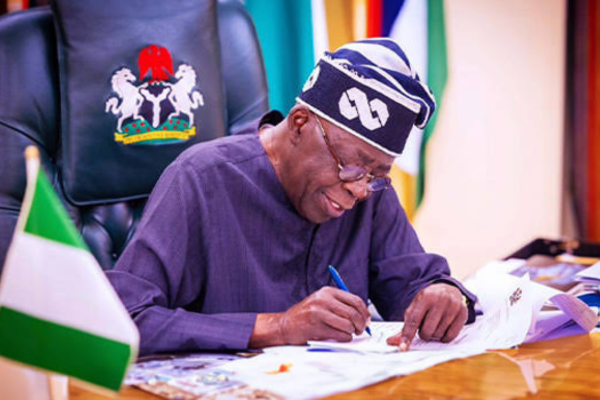
President Bola Ahmed Tinubu has signed the Executive Order on Virtual Assets Coordination, 2026, to create a unified framework for regulating virtual assets in Nigeria.
The directive, which takes immediate effect, is aimed at improving coordination among financial, revenue and capital market regulators while protecting investors and promoting responsible innovation.
The announcement was made on Friday by the President’s Special Adviser on Information and Strategy, Bayo Onanuga.
According to the Presidency, the order was signed under Section 5 of the 1999 Constitution (as amended) to address the fragmented regulation of virtual assets across government agencies.
It noted that the rapid growth of digital assets has blurred the lines between currencies, commodities, securities and other financial products, creating regulatory overlaps and enforcement gaps.
The government said these weaknesses have exposed Nigeria to money laundering, terrorism financing, cyber threats, data privacy risks and revenue losses.
The Presidency also said fraudulent and unregistered cryptocurrency operators have exploited the gaps to scam many Nigerians.
To improve coordination, the Executive Order establishes a Virtual Asset Council chaired by the Central Bank of Nigeria (CBN).
The Nigeria Revenue Service (NRS) and the Securities and Exchange Commission (SEC) will serve as vice-chairpersons, while the Nigerian Financial Intelligence Unit (NFIU) and the Office of the National Security Adviser (ONSA) are also members.
The council will work with the Attorney-General of the Federation to coordinate policy, improve information sharing and strengthen oversight through a unified supervisory platform.
A Virtual Asset Office will also be established at the CBN to oversee compliance, process applications and support innovation without creating additional regulatory burdens.