










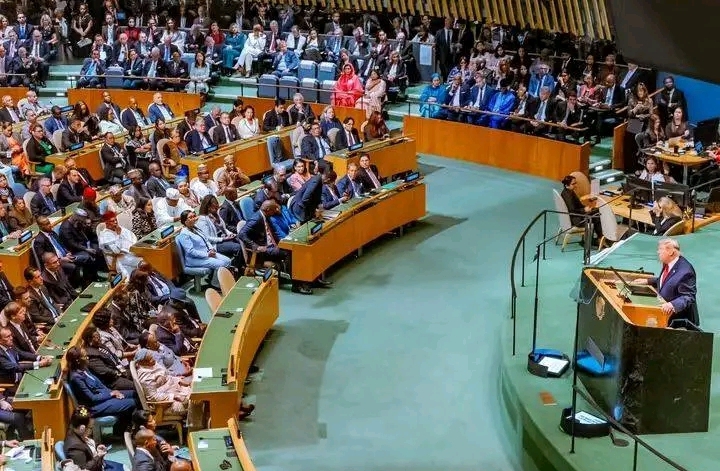
Several prominent world leaders are not physically attending the 81st United Nations General Assembly in New York, with vice presidents, foreign ministers and other senior officials representing their countries.
The UN says nearly 130 heads of state and government are attending the High-Level Week in person, which runs from September 22 to 28, 2026.
Among the notable absentees are Nigeria’s President Bola Ahmed Tinubu, China’s President Xi Jinping, Russia’s Vladimir Putin, Italy’s Prime Minister Giorgia Meloni, Mexico’s President Claudia Sheinbaum, German Chancellor Friedrich Merz and South African President Cyril Ramaphosa.
Nigeria
President Bola Ahmed Tinubu is not attending the General Assembly in New York.
Vice President Kashim Shettima is leading Nigeria’s delegation and is scheduled to deliver the country’s national statement.
The Federal Government said Tinubu mandated Shettima to represent him at the gathering and participate in high-level meetings and bilateral engagements.
The Presidency has not publicly given a specific reason for Tinubu’s absence.
China
Chinese President Xi Jinping is also absent from the New York gathering.
Vice President Han Zheng is representing China at the General Debate from September 24 to 26.
Beijing said Han will present China’s positions on international and regional issues and meet with the UN Secretary-General and other leaders.
Xi’s absence coincides with his state visit to Washington, where he is scheduled to meet US President Donald Trump.
The timing has made the US-China engagement a major diplomatic focus during the UNGA week.
Russia
Russian President Vladimir Putin is not travelling to New York for the Assembly.
Foreign Minister Sergey Lavrov is leading the Russian delegation after Putin formally ordered him to head the country’s UNGA mission.
Russia’s delegation also includes its UN ambassador Vasily Nebenzya and other senior officials.
The presidential decree appointing Lavrov does not state why Putin himself will not attend.
Italy
Italian Prime Minister Giorgia Meloni is another major leader missing from this year’s General Assembly.
Foreign Minister Antonio Tajani is leading the Italian delegation in New York.
Meloni has cited a heavily packed schedule, following several international summits in a short period, as well as several matters requiring her attention in Italy.
Tajani has already attended the opening of the General Assembly and is holding a series of diplomatic meetings on behalf of the Italian government.
Mexico
Mexican President Claudia Sheinbaum is also not attending UNGA 81.
Foreign Secretary Roberto Velasco Álvarez is representing her in New York.
Sheinbaum announced in July that she would not attend the General Assembly. Velasco subsequently took part in the opening of the General Debate on her behalf.
Available reports do not establish a more specific official reason for her decision.
Germany
German Chancellor Friedrich Merz had originally been expected to travel to New York but cancelled his participation.
Germany is instead represented by Foreign Minister Johann Wadephul and other senior members of the government.
The German government said Merz’s presence was required in Germany because of important domestic matters and the considerable time required for the trip.
Officials stressed that Germany remains fully represented at the UN despite the Chancellor’s absence.
South Africa
South African President Cyril Ramaphosa is also absent from UNGA 81.
Foreign Minister Ronald Lamola is representing him in New York.
South African media reported that Ramaphosa and Deputy President Paul Mashatile had been declared medically unfit for official duties, resulting in Lamola’s representation of the President at the UN.
Lamola has already delivered remarks at UNGA events on behalf of Ramaphosa.
South Africa is using the gathering to promote multilateralism, reform of global institutions and permanent African representation on the UN Security Council.
A Different Kind of UNGA
The absence of several prominent leaders has given the 81st General Assembly a notable diplomatic character.
However, their countries remain represented through senior officials with authority to deliver national statements and conduct diplomatic engagements.
The UN’s official programme indicates that nearly 130 heads of state and government are still attending the High-Level Week in person.
The absences therefore do not amount to the countries’ withdrawal from the Assembly, but rather reflect different national decisions over who should lead their delegations at this year’s gathering.