














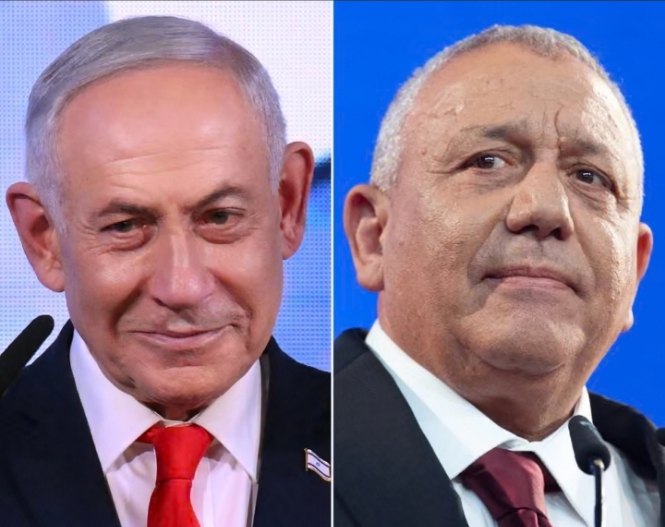
Arab Parties Offer Crucial Support to Eisenkot as Netanyahu Faces Battle to Retain Power
Arab political parties in Israel have offered to support opposition leader Gadi Eisenkot in efforts to remove Prime Minister Benjamin Netanyahu from power, potentially making Arab lawmakers decisive players in the formation of the country’s next government.
The offer comes after Israel’s October 27, 2026, parliamentary election produced a hung Knesset, with neither Netanyahu’s governing bloc nor the opposition securing the 61 seats required to form a majority government.
Veteran Arab lawmaker Ahmad Tibi said the Joint List was prepared to support an alternative government led by Eisenkot or another opposition candidate, but ruled out participating directly in the administration.
Speaking to Israel’s Channel 12, Tibi said Arab lawmakers wanted to contribute to political change without seeking ministerial appointments or positions in the cabinet.
“We want to help anyone who wants to bring down this awful government,” he said, describing the proposed arrangement as an opportunity to correct Israel’s political direction.
Tibi urged Eisenkot to follow the example of former Israeli Prime Minister Yitzhak Rabin, who relied on Arab lawmakers’ parliamentary support to advance the Oslo Accords with the Palestine Liberation Organisation.
“But without the Arab parties there won’t be change,” Tibi warned.
Arab Parties Secure 19 Seats, Become Kingmakers
The election results have significantly increased the political influence of Arab lawmakers in the 120-member Knesset.
The Joint List, an alliance of three Arab political factions, secured 11 seats, while Ra’am, another Arab-led party, won eight.
Together, they control 19 seats, representing a record parliamentary presence for Arab-led parties.
The final results show Netanyahu’s Likud-led bloc with 53 seats, while Eisenkot’s opposition-aligned parties hold 48.
The remaining 19 seats belong to the two Arab-led parties. If all the anti-Netanyahu parties cooperate, they could command 67 seats, six above the 61-seat threshold required for a parliamentary majority.
However, securing that majority will not be automatic.
Several influential opposition parties, including Eisenkot’s Yashar, Naftali Bennett’s B’Yachad and Avigdor Liberman’s Yisrael Beiteinu, have previously ruled out forming a coalition with the Arab factions.
This position presents a major obstacle to Eisenkot’s ambition of replacing Netanyahu.
The Associated Press reports that the Arab parties could nevertheless provide external parliamentary support for a minority government without formally joining its cabinet.
Arab Voter Turnout Surges To Nearly 80 Per Cent
The increased parliamentary representation followed a dramatic rise in Arab voter participation.
According to Joint List chairman Yousef Jabareen, turnout among Arab voters increased from approximately 38 per cent in the 2022 election to nearly 80 per cent in the October 27, 2026, election.
Jabareen attributed the increase to widespread dissatisfaction with Netanyahu’s administration, particularly the policies of National Security Minister Itamar Ben-Gvir and Finance Minister Bezalel Smotrich.
He also cited anti-Arab rhetoric and escalating violent crime in Arab communities as major factors behind the mobilisation.
Jabareen described the election as an emergency situation in which Arab voters believed their political future and security were at stake.
Tibi similarly characterised the increased participation as an act of self-defence against the outgoing government.
Joint List Presents Conditions For Supporting Eisenkot
Although the Joint List has expressed willingness to support a new government, Jabareen has outlined several conditions that could complicate negotiations.
The first is a commitment to a diplomatic process towards establishing an independent Palestinian state.
The party is also demanding a properly funded government programme to address violent crime in Arab municipalities.
Another condition is an end to home demolitions, which have remained a contentious issue in relations between Arab communities and Israeli authorities.
These demands could create disagreements with some of Eisenkot’s potential political partners, particularly those opposed to Palestinian statehood.
The position is especially complicated because several Jewish-led opposition parties have maintained that they would not accept certain concessions involving Palestinian statehood.
Nevertheless, Jabareen confirmed that preliminary contacts had already taken place with Eisenkot, Democratic Party leader Yair Golan and representatives of Bennett’s B’Yachad.
He said the discussions were informal and had not yet developed into formal coalition negotiations.
No comparable discussions had taken place with Liberman, according to Jabareen.
Hamas Position Emerges As Major Obstacle
Another potentially contentious issue is the Joint List’s position on Hamas.
Eisenkot has reportedly made an explicit condemnation of Hamas as a terrorist organisation one of his requirements for potential coalition partners.
However, Jabareen declined to describe Hamas in those terms when repeatedly questioned during his Channel 12 interview.
He maintained that the Joint List had condemned the October 7, 2023, attacks on Israeli communities.
“We said we condemn the slaughter in the communities on the Gaza border,” he said.
However, when pressed to explicitly classify Hamas as a terrorist organisation, Jabareen responded: “My dear, I am not in an interrogation room.”
His response could complicate negotiations with Eisenkot and other Jewish-led opposition parties, particularly given the political and security implications of the October 7 attacks.
The disagreement highlights the difficult balance between the Joint List’s political demands and the security conditions being advanced by potential partners.
Qatar Election Interference Allegations Disputed
Meanwhile, allegations of foreign interference have introduced another controversy into Israel’s post-election political crisis.
Netanyahu and members of his Likud party reportedly suspected that Qatar secretly financed efforts to increase Arab voter participation during the election.
The allegations prompted Israel’s domestic security agency, Shin Bet, to open a limited investigation into suspected foreign funding and possible electoral interference.
Tibi rejected the allegations, insisting that the Joint List had not received illicit funding from Qatar or any other foreign government.
He also accused Shin Bet chief David Zini of influencing Central Elections Committee chairman Justice Noam Sohlberg to announce the investigation following an alleged meeting with Netanyahu.
Tibi questioned the appropriateness of such an investigation involving allegations against political opponents.
However, the accusations against Zini remain Tibi’s claims and have not been independently established.
According to reporting by The Times of Israel, the alleged Qatari interference had not been substantiated. Shin Bet sources also indicated that the investigation could not affect the election results.
The Central Elections Committee similarly indicated that the investigation was limited in scope and would not invalidate the election outcome.
Netanyahu Faces Three Possible Political Outcomes
The election has left Israel facing difficult negotiations over the formation of its next government.
According to an analysis by the US Congressional Research Service published on October 30, President Isaac Herzog is expected to assign the mandate to form a government following publication of the election results.
Under the process outlined in the report, the designated candidate would have 28 days to form a government, with a possible 14-day extension.
Three major political scenarios have emerged.
1\. Eisenkot forms a government with Arab support
Eisenkot could attempt to assemble a parliamentary majority with the backing of the Joint List and Ra’am.
Such an arrangement could give Netanyahu’s opponents 67 seats, although resistance among Jewish-led opposition parties could make the proposal difficult to implement.
2\. Netanyahu negotiates a unity government
The prime minister could attempt to persuade Eisenkot and other opposition figures to join a national unity administration.
Such an arrangement could produce a 67-seat parliamentary majority.
However, Eisenkot and his allies have previously rejected serving under Netanyahu, accusing him of responsibility for security failures surrounding the October 7 attacks and raising concerns about his corruption trial and democratic governance.
3\. Israel holds another election
If neither political camp can secure the required parliamentary support, Israel could face another general election, potentially in early 2027.
Netanyahu would remain in office in a caretaker capacity while the political stalemate continued.
The Associated Press has identified all three possibilities as major scenarios confronting Israel following the election.
What The Political Deadlock Means For Israel
The outcome of the election represents a significant moment for Arab political participation in Israel.
For the first time in this election cycle, Arab-led parties have secured 19 parliamentary seats, giving them considerable influence over negotiations to determine the country’s next government.
However, their numerical strength does not automatically translate into political power.
The willingness of Jewish-led opposition parties to accept their support, the Palestinian question, disagreements over Hamas and demands for domestic reforms will determine whether the proposed arrangement can become reality.
For Eisenkot, the challenge is to assemble a parliamentary majority without alienating potential partners who oppose cooperation with Arab political factions.
For Netanyahu, the challenge is to prevent his opponents from translating their combined parliamentary strength into a functioning government.
The coming negotiations could therefore determine not only who becomes Israel’s next prime minister but also the future relationship between Jewish and Arab political representation in the country.
The new Knesset is scheduled to convene on November 10, 2026.