























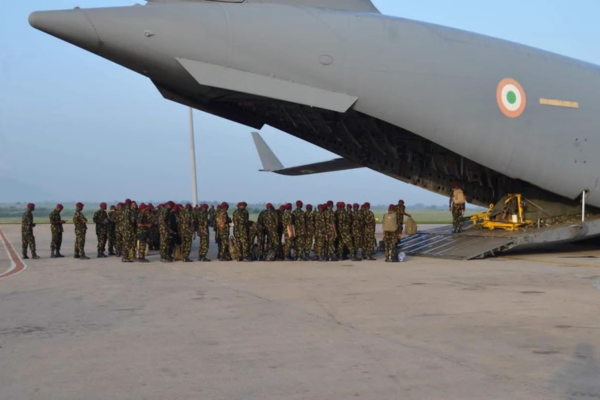
The Nigerian Army has deployed 300 soldiers to India for specialised jungle and mountain warfare training, with another 300 expected to join them in a subsequent deployment.
The first batch departed the Nnamdi Azikiwe International Airport in Abuja on Thursday, October 22, 2026, aboard two Indian Air Force aircraft, according to reports citing an Army operational report.
Major-General Umar Yusuf, Coordinator of Nigerian Army Military Training and Simulation at Army Headquarters, represented the Chief of Army Staff, Lieutenant-General Waidi Shaibu, at the departure ceremony.
The Indian High Commissioner to Nigeria was also present.
The training programme is designed to equip the soldiers with advanced skills for operating in difficult terrain, including mountainous regions and areas covered by dense vegetation.
Jungle and mountain warfare require specialised tactics for movement, navigation, communication and combat. Soldiers must also learn to manage logistics and coordinate operations in environments where visibility and mobility are limited.
The Nigerian Army expects the programme to strengthen the troops’ operational capabilities and improve their ability to respond to complex security situations.
Although Nigeria’s security challenges differ from those encountered in India, exposure to foreign military training methods could help personnel develop tactical flexibility and adapt useful techniques to local operations.
The deployment also highlights defence cooperation between Nigeria and India, providing opportunities for professional development and the exchange of military knowledge.
Nigeria continues to battle multiple security threats, including insurgency, banditry, kidnapping and other forms of armed violence in different parts of the country.
The effectiveness of the training will depend on how well the soldiers apply their new skills after returning to Nigeria and share their knowledge with other military personnel.
Beyond the number of soldiers trained, the programme’s success will ultimately be measured by improvements in operational effectiveness, civilian protection and the military’s ability to deliver lasting security gains.